
Louise Bourgeois
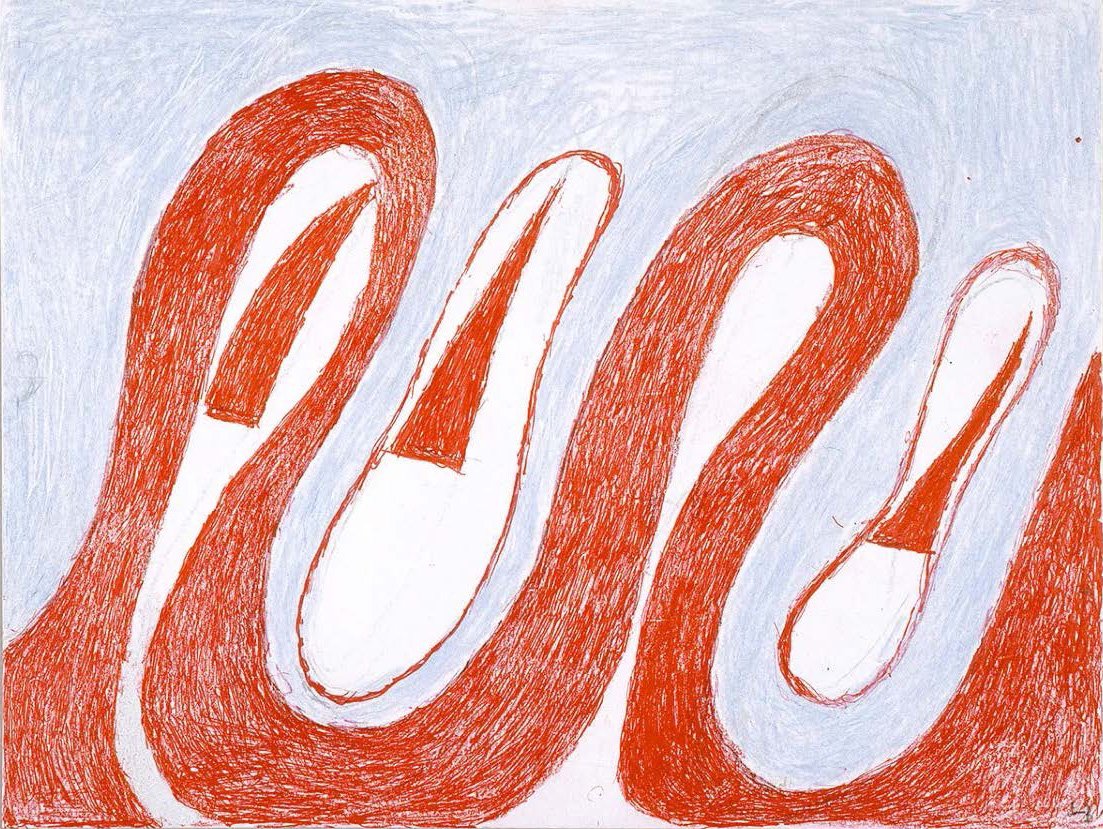
Untitled (Undulating Ribbon)
Louise Bourgeois (1911-2010) began developing her artistic skills early in life, assisting in her family's tapestry restoration workshop in France. Although she initially earned a degree in mathematics, she soon shifted her focus to art, studying formally at Paris’s École des Beaux-Arts and later taking private lessons.
In 1938, at the age of 27, she married American art historian Robert Goldwater and relocated with him to New York City. During her early years there, she balanced family life—raising three sons—with her creative work, producing drawings, paintings, and prints while attending classes at the Art Students League. She also connected with prominent figures in the art scene, including leading Surrealists and Abstract Expressionists. It was not until the 1950s that she began devoting herself primarily to sculpture.
Bourgeois’s work is characterized by its exploration of dualities—such as light and dark, rough and smooth, masculine and feminine—and frequently delves into powerful emotional states, often intertwined with themes of sexuality. She viewed art-making as a way to externalize, confront, and ultimately gain mastery over her inner feelings. Painful personal memories, particularly those involving her father’s decade-long affair with the family’s English nanny, became more manageable when transformed into physical artistic forms.
Although Bourgeois had exhibited her work steadily for many years, widespread acclaim came after her major retrospective at the Museum of Modern Art in 1982. In the decades that followed, her sculptures were widely exhibited across the United States and Europe. A comprehensive catalogue raisonné of her prints also sparked renewed attention to her two-dimensional pieces. In 1993, she was selected to represent the United States at the Venice Biennale.