
Cecily Brown
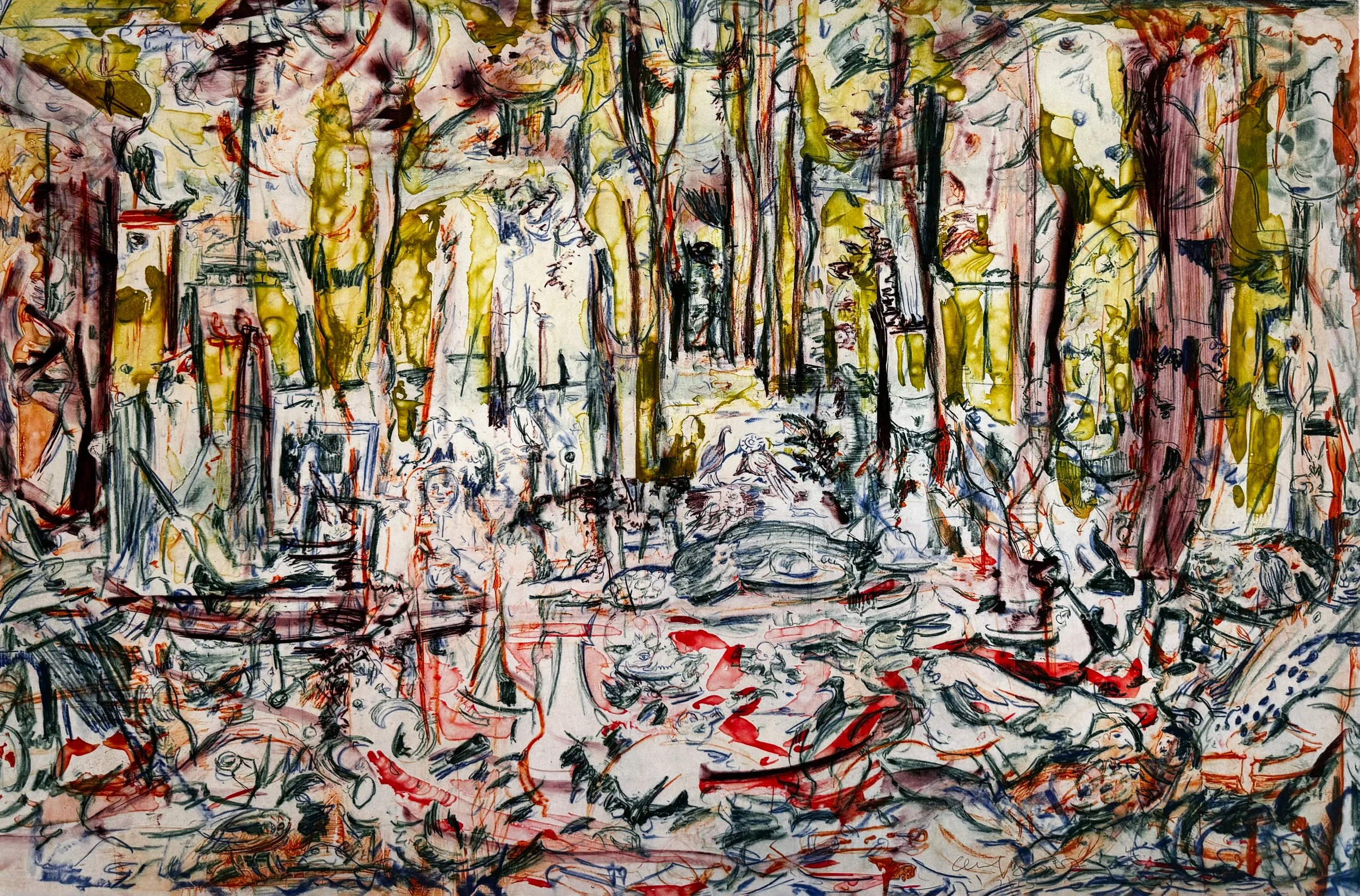
The Five Senses red yellow blue
Cecily Brown (b. 1969) is known for her dynamic paintings that seem to exist in a state of constant movement. Her work pulses with erotic energy, delivered through bold, expressive brushwork and luminous color. Oscillating fluidly between abstraction and figuration, her canvases draw from a wide range of influences, including master painters such as Paolo Veronese, Peter Paul Rubens, Edgar Degas, Willem de Kooning, Francis Bacon, and Joan Mitchell, as well as elements of popular culture. Rather than adhering to traditional narrative structures, Brown creates a sense of visual and thematic fluidity that feels perpetually alive.
She approaches the nude figure with particular vigor, liberating it from conventional contexts and expectations. By interspersing passages of startling clarity within her energetic visual language, she sustains an intense, ever-present immediacy in her work.
Born and raised in suburban Surrey, England, Brown first studied under painter Maggi Hambling before attending the Slade School of Fine Art, where she graduated in the early 1990s. Although this period overlapped with the emergence of the Young British Artists, she distanced herself from their conceptual approach, ironic tone, and fascination with celebrity. After spending six months in New York as an exchange student in 1992, she relocated there permanently in 1994. Alongside artists such as John Currin, she played a significant role in revitalizing figurative painting, helping to restore its energy and critical relevance.
Central to Brown’s practice is her remarkable ability to turn paint into flesh, embedding the human form within chaotic, fragmented explorations of desire, life, and mortality. Her breakthrough body of work in the mid-1990s featured hedonistic rabbits alongside references to still-life traditions, eventually evolving into the sensual, orgiastic scenes for which she became widely recognized. In her paintings, paint appears in constant transformation — shifting between liquid and solid, transparent and opaque — mirroring the restless energy of the compositions themselves.
As Brown has noted: “I think that painting is a kind of alchemy. The paint is transformed into image, and paint and image transform themselves into a third and new thing.”